
Alumni Spotlight: A Conversation with Benjamin Chu
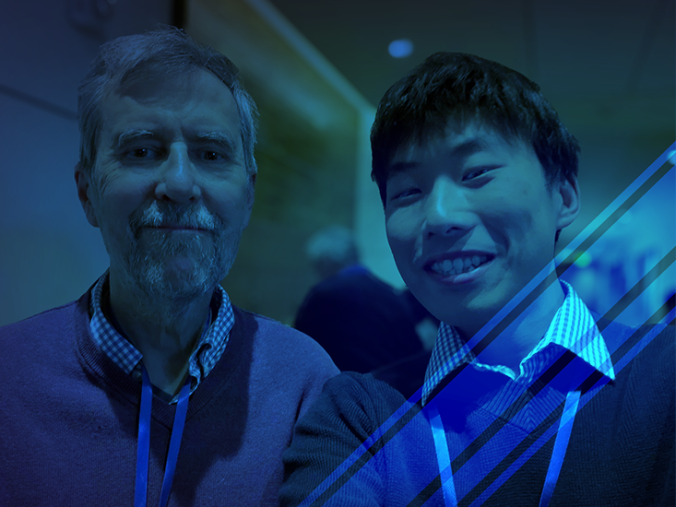
By Leticia Ortiz | Computational Medicine, UCLA
At the intersection of high-performance computing and human health lies the work of Benjamin Chu Ph.D.. A Principal Scientist at Genentech, Ben specializes in developing statistical and mathematical methods to decode the complexities of human genetics/genomics. His position at Genentech follows his postdoctoral training at Stanford University with Chiara Sabatti.
A pivotal chapter in Ben’s journey took place right here at UCLA, under the mentorship of Distinguished Professor Ken Lange and co-advised by Janet Sinsheimer. Ben credits his time working with Dr. Lange has had a profound and positive impact on his career trajectory.
To understand the significance of this mentorship, one must look at Dr. Lange’s pioneering contributions to the field. A recent inductee to the National Academy of Sciences and recipient of the American Society of Human Genetics 2020 Motulsky-Childs Award, Dr. Lange’s work in genetic epidemiology and optimization theory has shaped the discipline. Many of his landmark papers on hidden Markov chains and Markov chain Monte Carlo predated the current flood of biological applications by decades. As the former Chair of the Department of Human Genetics and the Department of Biomathematics (now Computational Medicine), Dr. Lange has fostered a generation of scientists equipped to tackle the hardest problems in biology. He has further empowered the community through his development of Mendel—a software package often described as the "Swiss army knife" of statistical genetics—marking a significant and lasting technical contribution to the field.
In this interview, we discuss how Ken Lange’s exceptional mentorship helped to prepare Ben for his current role at Genentech, where he applies these advanced statistical techniques to the frontline of medical research.
How did Professor Lange’s expertise in optimization and scientific computing influence your own research focus on statistical methods for human genetics?
Ken always liked to approach problems in unconventional ways. When others were mainly exploring L1 or L2 penalties, he encouraged me to pursue L0. When hidden Markov models were the standard for genotype imputation, he asked whether alternatives might work better/faster. He was never constrained by what was fashionable — only by what was *interesting*: whether it's new mathematics, new efficiency gains, or new science.
Of course, this kind of innovation requires extraordinary theoretical breadth and persistence. It also requires a certain fearlessness — a willingness to struggle alone with an idea long before others see its value. This deeply shaped my own thinking.
Over time, I also came to understand my own strengths. While I may not always take the most unconventional route, my training with Ken exposed me to techniques and ways of thinking that I would never have encountered otherwise. When I do research now, I do so with a deeper appreciation for the math underneath them. His influence broadened my intellectual toolkit and raised my standards for rigor/creativity.
You mention a strong interest in writing efficient and user-friendly software packages. Did your training under Professor Lange at UCLA play a specific role in developing your standards for scientific software?
Yes of course, Ken has developed many, many methods for statistics, genetics, and optimization. I will always stare in awe at the 300+ page Mendel documentation. It shows the importance of detail, examples, clarity, and (something that's never found in software manuals) humor.
Let me also mention that because Ken pioneers all these methods, his students are rarely just extending an existing framework. We often build things from the ground up, both the theory and its practical application. Those experiences naturally trained us to think end-to-end: from deriving the algorithms/math/etc., to implementing efficient code, to packaging, testing, documenting, and distributing software that others could reliably use.
That standard has stayed with me. To this day, I view writing clear, well-documented, and thoughtfully designed software not as an afterthought, but as an integral part of doing good science — a value I learned directly from him.
How did the mentorship you received during your PhD in biomathematics prepare you for your subsequent work as a postdoc at Stanford and your current role as a Principal Scientist at Genentech?
One remarkable aspect of Ken’s mentorship is that even learning just a handful of his “tricks” can sustain an entire career. Even something that seems very basic, like least squares and maximum likelihood estimation, turned out to be incredibly useful and can be used in very nontrivial ways when you can apply them creatively. I still find myself applying principles I first learned in his office to entirely new problems years later.
But to the question about how prepared I was for postdoc and beyond, I'd say one explicit message that has stayed with me is to "become an autodidact". It was clear early on that there would always be more to learn. Even someone with Ken’s vast knowledge continues to learn daily. So I know the goal is not to know everything before starting something new, but to keep learning – and to learn how to learn. It sounds cliche but it's true, in academia or industry alike.
What specific advice or guidance from Professor Lange has stuck with you most as you moved from academia into the biotechnology industry?
Ken has given a lot of explicit advice — from his “Advice to Young Mathematical Biologists” to his notes on scientific writing — many of which shaped me profoundly during my PhD years and beyond. Those are interesting reads, so I hope the reader can find copies of them somewhere.
Besides the message on becoming an autodidact (which I already mentioned above), perhaps his most important lesson was non-verbal: he is my role model. I saw what certain "good qualities" actually look like in real life: humility, curiosity, generosity, and fearlessness. He demonstrated what passion looks like, that brilliance and kindness are not mutually exclusive, and that you can be humble and firm at the same time. I think having a good role model in life is a rare gift. Methods evolve, fields change, and careers take unexpected turns — but a mental role model will always be there. I feel deeply grateful that Ken was that example for me.
—
On January 26th, 2026, we held the Sixth Annual Lange Symposium at UCLA.
Please see some of the talks on our YouTube channel.
Ken Lange Symposium Endowment