
All News

Computational Medicine continues to expand its faculty by recruiting professors with primary appointments in other departments and recent PhDs as Assistant Adjunct Professors. The new faculty complement the research of our current faculty and students and contribute to the community by serving on committees and participating in CGSI and other activities.

The UCLA Science Hub for Humanity and Artificial Intelligence, a collaboration with Amazon, announced today its first cohort of 12 Amazon fellowships and six gift-funded research projects.

UCLA Computational Medicine and Statistics professor Jingyi Jessica Li won one of the 2023 COPSS Emerging Leader Awards. The award recognizes the talents, leadership potential, and achievements of high-potential early career statistical scientists.

UCLA Computational Medicine and Statistics professor Jingyi Jessica Li won one of the 2023 COPSS Emerging Leader Awards. The award recognizes the talents, leadership potential, and achievements of high-potential early career statistical scientists.

Please join us on May 15 for the prestigious, honorary John H. Walsh Young Investigators Research Prize Seminar.
Dr. Valerie A. Arboleda presents her research on Unraveling the Influence of Genetics in Human Disease.
- and -
Dr. Weizhe Hong presents his research on Understanding the Social Brain.

The Department of Computational Medicine is pleased to announce a new online, self-supporting graduate program called the Master of Science in Data Science in Biomedicine. The program will combine foundational training in all areas of data science including machine learning, statistics, data

Charlotte Bhaskar, PLOS | cbhaskar@plos.org
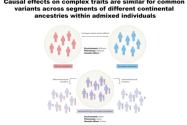
Elizabeth G. Atkinson | Nature Genetics
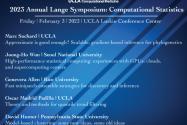
Computational Medicine and Human Genetics at UCLA, with support from NIH, held the third Lange Symposium on Feb 3, 2023. The topic for this year’s symposium was Computational Statistics. This annual event celebrates the impact of Dr. Lange’s research, mentorship, and teaching over the course of an illustrious career spanning more than four decades.

Brain changes in people with autism are more far-reaching than previously thought, occurring throughout the cerebral cortex rather than being confined to certain areas thought to affect social behavior and language.